


Choosing a skid steer loader is not simply a matter of buying the biggest machine your budget allows. The right machine depends on what you are moving, where you are working, which attachments you plan to use and how much hydraulic performance those attachments require.
A machine that is well suited to loading soil around a construction site may not be the right choice for soft ground, restricted access or demanding hydraulic attachments.
This guide explains the skid steer specifications that matter and how to match them to the work you need the machine to do.
Start with the job, not the machine
Before choosing a skid steer, know your heaviest regular load, working surface, site access, required attachments and the hydraulic flow those attachments need.
In This Guide
Start With the Job, Not the Skid Steer
Before comparing engine power, bucket capacity or machine size, work out exactly what the skid steer will spend most of its time doing.
| Main Job | What Matters Most |
|---|---|
| Loading soil or aggregate | Operating load, bucket capacity, lift height and cycle time |
| Pallet handling | Operating capacity, attachment suitability and machine stability |
| Soft or muddy ground | Tracks, traction and ground contact area |
| Concrete or sealed yards | Tyres, manoeuvrability and travel speed |
| Auger work | Hydraulic flow and attachment requirements |
| Planing or milling | Hydraulic flow, working pressure and attachment compatibility |
| Restricted worksites | Machine width, height and turning space |
A useful starting point
Choose the machine around the work you perform most often rather than selecting the largest machine available.
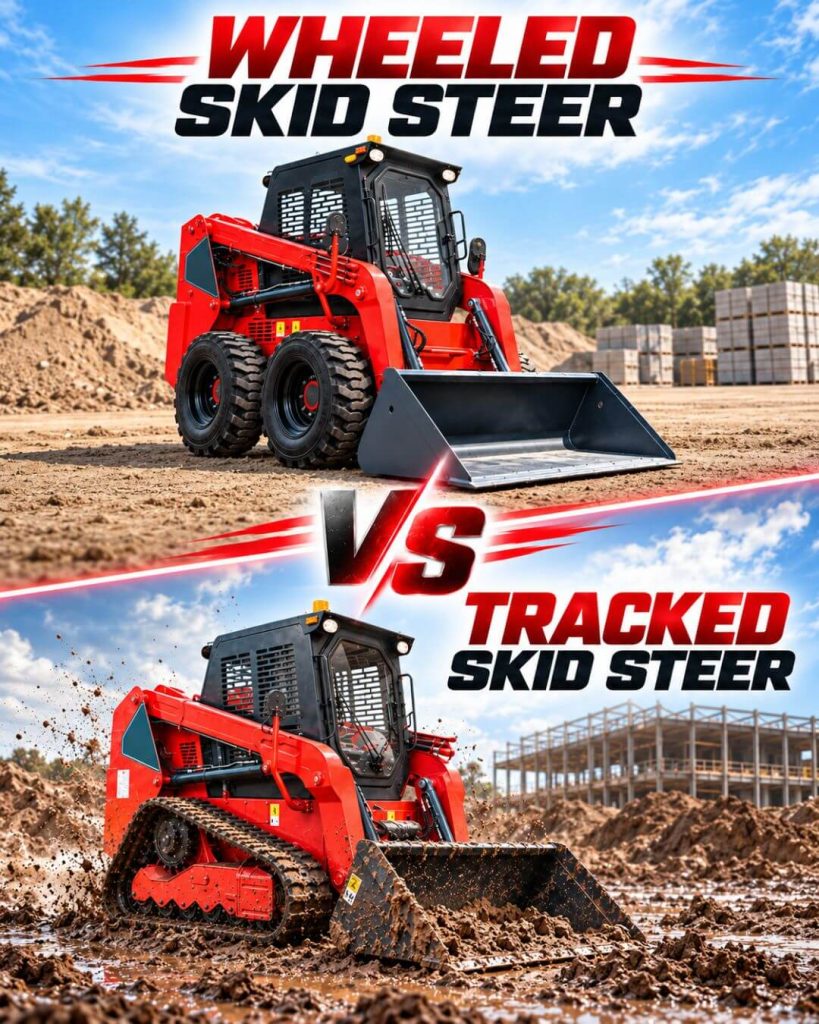
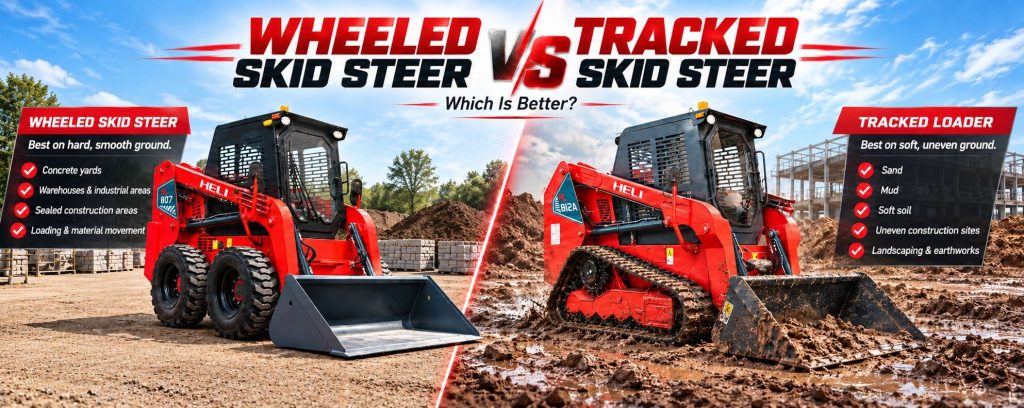
Wheeled or Tracked Skid Steer, Which Is Better?
Neither option is automatically better. Wheels and tracks are suited to different working conditions.
Wheeled Skid Steer
Wheeled skid steers are commonly suited to hard and relatively smooth surfaces where manoeuvrability, travel speed and straightforward tyre maintenance are important.
Often suited to- Concrete yards
- Warehouses and industrial areas
- Sealed construction areas
- Loading and material movement
Tracked Skid Steer
Tracks provide a larger ground contact area. HELI describes the HL812A tracked design as providing stronger traction and improved performance on soft or complex ground.
Often suited to- Mud
- Sand
- Snow
- Wetland
- Rough or uneven terrain
- Landscaping and earthworks
If soft or uneven ground is a major part of your work, see the HELI HL812A tracked skid steer loader .
Understand the Capacity Figures Before Comparing Machines
Capacity is one of the most important skid steer specifications, but the terminology on a specification sheet needs to be read carefully.
HELI separately lists Operating Load and Max.Loading for these machines.
We recommend comparing machines using the manufacturer’s stated operating figures and confirming the suitability of the machine for the load, attachment and working conditions. The larger Max.Loading figure should not be treated as the normal working capacity without confirmation from the manufacturer or supplier.
Do not ask only, how much can it lift?
Ask what operating load applies to the work, attachment and conditions in which the machine will actually be used.
Bigger Is Not Automatically Better
Moving to a larger skid steer can give you greater operating load, increased engine power and a larger bucket, but there are trade-offs.
- A heavier machine can require different transport arrangements.
- A wider machine may not fit through restricted access points.
- A larger machine may use more fuel.
- Turning space can become more important on confined sites.
- You may be paying for capacity you rarely need.
The aim is to select a machine that comfortably handles the normal job while remaining practical for your site and attachments.
Engine Power Is Only Part of the Story
Engine power is easy to compare, but many skid steer attachments rely on the machine’s hydraulic system.
If attachments are important to your work, check the following.
- Rated hydraulic flow, measured in litres per minute
- Working system pressure
- High flow availability
- The hydraulic requirements of the attachment
A higher engine power figure does not automatically mean every hydraulic attachment will perform better. The skid steer and attachment need to be matched correctly.
Standard Flow and High Flow Hydraulics
Many everyday attachments can operate using the standard auxiliary hydraulic circuit. More demanding hydraulic attachments can require considerably greater flow.
Standard Hydraulic Flow
Suitable for many everyday skid steer functions and compatible hydraulic attachments, depending on the attachment manufacturer’s requirements.
High Flow
Provides greater hydraulic flow for attachments that require more hydraulic output.
HELI lists the HL807, HL808 and HL809 with rated hydraulic flow of 80 L/min.
The wheeled HL812 is listed with 74 L/min rated flow and 136 L/min high flow.
The tracked HL812A is listed separately with 74 L/min rated flow and 140 L/min high flow.
A useful attachment rule
Check the hydraulic flow and pressure required by the attachment, then confirm that the skid steer can supply it.
Radial Lift and Vertical Lift
Skid steer loaders can use different loader arm geometries. Two common configurations are radial lift and vertical lift.
Radial Lift
A radial lift path moves the loader arms through an arc as the bucket rises.
Vertical Lift
A vertical lift design uses different loader geometry to keep the load path more upright during the lifting cycle.
HELI lists the HL807, HL808, HL809, HL812 and tracked HL812A models in these brochures as Radial lifting type.
The Attachment Can Determine the Machine
Much of the versatility of a skid steer comes from the ability to use different attachments. That also means attachment requirements should be considered before the machine is selected.
Before selecting a machine, check the following.
- The attachment weight
- The hydraulic flow required
- The hydraulic pressure required
- The attachment and coupler compatibility
- The working capacity of the complete machine and attachment combination
Measure the Site Before Choosing the Machine
Skid steers are designed to work in areas where larger loaders may struggle, but different models still have different dimensions.
Check the following before making a decision.
- Gate width
- Doorway width
- Machine width
- Machine height
- Turning space
- Overhead restrictions
- Transport requirements
The HELI wheeled range listed in the manufacturer brochure varies from 1,730mm to 1,818mm wide. The tracked HL812A is listed separately at 1,880mm wide.
HELI Wheeled Skid Steer Loader Comparison
The following figures come from the HELI HL807, HL808, HL809 and HL812 Multi-function Skid Steer Loader specification sheet.
| Specification | HL807 | HL808 | HL809 | HL812 |
|---|---|---|---|---|
| Rated Power | 39kW | 45kW | 45kW | 65kW |
| Operating Load | 730kg | 830kg | 930kg | 1,200kg |
| Max.Loading | 1,460kg | 1,660kg | 1,860kg | 2,400kg |
| Lifting Type | Radial | Radial | Radial | Radial |
| Bucket Capacity | 0.47m³ | 0.47m³ | 0.51m³ | 0.53m³ |
| Working System Pressure | 180 bar | 180 bar | 180 bar | 235 bar |
| Rated Flow | 80 L/min | 80 L/min | 80 L/min | 74 L/min |
| High Flow Flux | Not listed | Not listed | Not listed | 136 L/min |
| Width | 1,730mm | 1,730mm | 1,818mm | 1,798mm |
| Self-weight With Bucket | 2,850kg | 2,980kg | 3,230kg | 3,970kg |
Figures are taken from the HELI manufacturer specification sheet supplied for the HL807, HL808, HL809 and HL812. Specifications should be confirmed before purchase because manufacturer specifications may change.
HELI HL812A Tracked Skid Steer Loader
The HL812A is a separate tracked machine and should not be confused with the wheeled HL812. Although the model names are similar, several specifications are different.
| Specification | HL812A |
|---|---|
| Operating Load | 1,200kg |
| Rated Power | 65kW |
| Max.Loading | 3,428kg |
| Lifting Type | Radial |
| Bucket Capacity | 0.55m³ |
| Working System Pressure | 235 bar |
| Rated Flux | 74 L/min |
| High Flow Flux | 140 L/min |
| Fuel Tank Capacity | 125L |
| Self-weight With Bucket | 4,400kg |
| Width | 1,880mm |
| Bucket Width | 1,980mm |
Important
HL812 and HL812A are different machines. The wheeled HL812 has a Self-weight With Bucket of 3,970kg and high flow of 136 L/min. The tracked HL812A has a Self-weight With Bucket of 4,400kg and high flow of 140 L/min.
View the HELI HL812A tracked skid steer loader or compare the complete HELI skid steer loader range .
Before You Buy, Know These 8 Things
- Your heaviest regular load
- The main job the machine will perform
- The ground conditions
- The attachments you intend to use
- The hydraulic flow and pressure required
- The required lift or dumping height
- The narrowest site access point
- The expected daily operating hours
Give us those answers and we can help narrow the choice to a fit-for-purpose machine.
Questions to Ask Before Buying a Skid Steer Loader
A specification sheet tells you a lot, but the correct machine still needs to match the work. Before buying, ask the supplier the following.
- What is the manufacturer’s stated Operating Load?
- What does the manufacturer’s Max.Loading figure represent?
- Is the machine radial lift or vertical lift?
- What is the standard hydraulic flow?
- Is high flow available?
- What working hydraulic pressure is available?
- Which attachments are compatible?
- How does the attachment affect the usable working capacity?
- What is the Self-weight With Bucket?
- What are the overall width and height?
- Would wheels or tracks be more appropriate for the site?
- Are replacement parts stocked locally?
- Who performs servicing and repairs?
- What warranty applies?
- Can the machine be inspected or demonstrated before purchase?
Skid Steer Loader FAQs
What size skid steer loader do I need?
Start with the load, main application, attachment requirements, ground conditions and site dimensions. A larger skid steer gives greater capacity, but a smaller machine may be better where access and manoeuvrability matter.
Is a tracked skid steer better than a wheeled skid steer?
It depends on the site. HELI describes its tracked HL812A as providing increased ground contact, stronger traction and reduced ground damage on soft or complex terrain. Wheeled machines remain well suited to many hard and firm working surfaces.
What does Operating Load mean on the HELI skid steer specification?
HELI lists Operating Load separately from Max.Loading. The machine should be selected using the appropriate manufacturer’s working figures for the application rather than assuming the larger Max.Loading figure represents normal operating capacity.
Do I need high flow hydraulics?
Only if the attachment requires it. Check both hydraulic flow and working pressure requirements before selecting the machine.
What is the difference between HL812 and HL812A?
HL812 is the wheeled model in the HELI HL807, HL808, HL809 and HL812 range. HL812A is a separate crawler or tracked skid steer loader. Both list a 1,200kg Operating Load, but other specifications including Max.Loading, bucket capacity, high flow, width and Self-weight With Bucket are different.
What attachments can a skid steer loader use?
Depending on the machine and hydraulic requirements, skid steers can work with buckets, pallet forks, augers, grapples, sweepers, trenchers, planers and other compatible attachments. Confirm the attachment requirements before use.
Allied Forklifts Equipment Guide
Technical figures in this guide have been taken from HELI manufacturer specification sheets for the HL807, HL808, HL809, HL812 and HL812A. Specifications should always be confirmed before purchase because manufacturer specifications and available configurations may change.
Need Help Choosing?
Tell Us What You Need the Machine to Do
Tell us the work, load, ground conditions and attachments you plan to use. We can help you narrow the choice to a fit-for-purpose skid steer loader.
View HELI Skid Steer Loaders