

A reach stacker is a heavy-duty container handling machine designed to lift, move and stack shipping containers using a telescopic boom and container spreader. Unlike a conventional forklift, a reach stacker can reach forward beyond the first row of containers, making it particularly useful in ports, freight terminals, container depots, transport yards and intermodal operations.
For operations handling loaded containers, that ability to lift at height and reach into multiple rows can make a major difference to yard capacity and container movement.
But capacity needs to be understood properly. A machine described as a 45 tonne reach stacker will not necessarily lift 45 tonnes at every height and every forward reach. Container weight, stacking height, row position, load centre and the machine’s load chart all matter.
A forklift primarily lifts a load in front of the machine. A reach stacker combines heavy lifting with a telescopic boom, allowing the container spreader to move vertically and forward so containers can be positioned across multiple rows.
What Is a Reach Stacker?
A reach stacker is a mobile, heavy-duty machine used primarily for handling ISO shipping containers. The machine uses a telescopic boom rather than a conventional forklift mast, with a purpose-built spreader mounted at the end of the boom to engage the container.
This arrangement allows the operator to lift a container, transport it over short distances and place it into a stack. More importantly, the boom can reach over the first row of containers to position loads into second and, depending on the machine and load, third-row locations.
That combination of mobility, lifting capacity and forward reach is why reach stackers are commonly used in container terminals, freight yards and industrial facilities where fixed container handling infrastructure may not be practical.
How Does a Reach Stacker Work?
The basic principle is straightforward. The operator positions the machine near the container and uses the telescopic boom to move the spreader into position above it. The spreader locks onto the container’s corner castings, allowing the machine to lift and reposition the container.
Several major systems work together during this process:
- Telescopic boom provides vertical lift and forward reach.
- Container spreader connects securely to the shipping container.
- Hydraulic system controls boom and spreader movement.
- Counterweighted chassis provides the stability required for heavy lifting.
- Powertrain and drive axle allow the machine to move containers around the yard.
- Load monitoring systems help the operator work within the machine’s permitted operating envelope.
The ability to move the spreader sideways, rotate it and adjust its position can also help an operator align with containers accurately without constantly repositioning the entire machine.
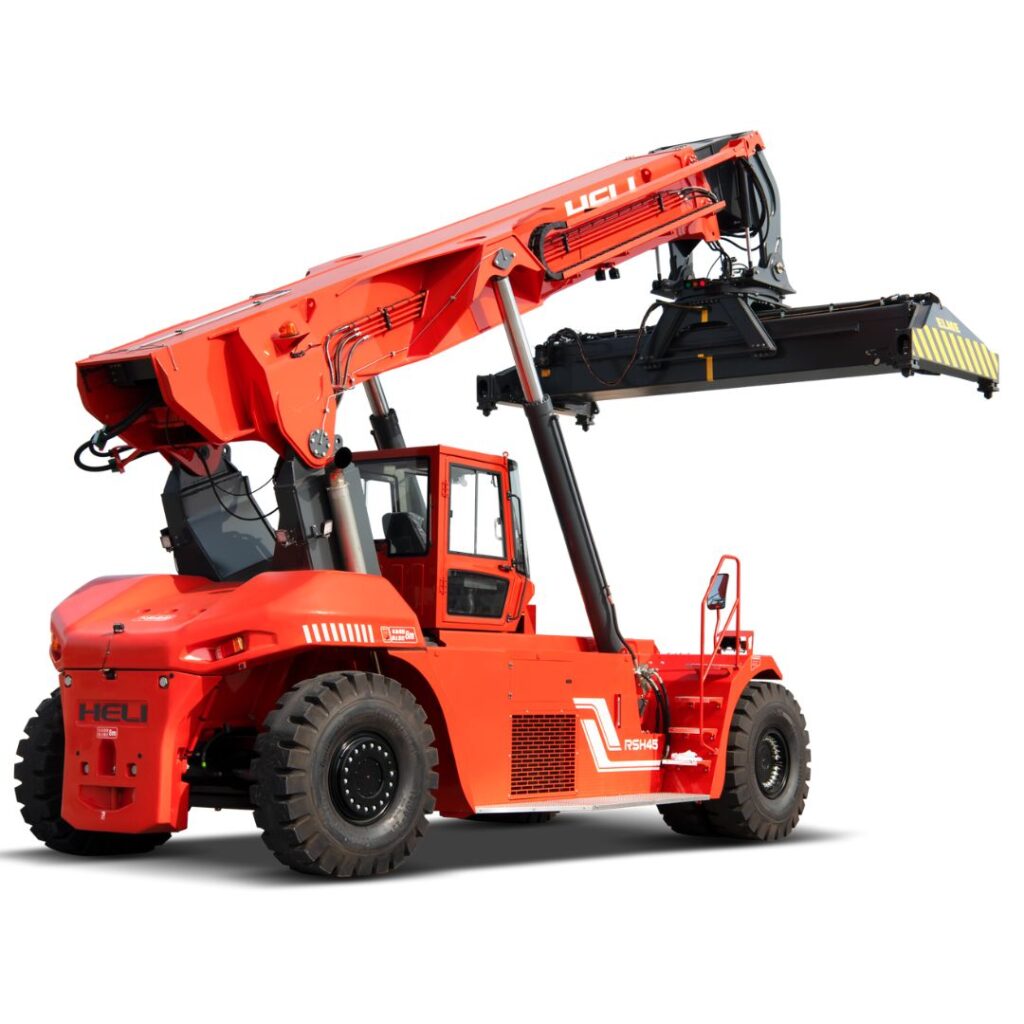
HELI RS45 reach stacker configured for heavy container handling.
Why Use a Reach Stacker for Container Handling?
The biggest advantage of a reach stacker is flexibility. It can collect containers from trucks, move them around a yard and place them into stacks without requiring fixed lifting infrastructure.
The telescopic boom also allows containers to be positioned beyond the first row. That can help an operation use available yard space more effectively, particularly where container density is important.
Typical applications include:
- Shipping and container terminals
- Intermodal freight depots
- Transport and logistics yards
- Container storage facilities
- Import and export operations
- Mining and resources projects
- Industrial and manufacturing sites
- Defence and marine logistics operations
Reach Stacker Capacity: Why 45 Tonnes Does Not Always Mean 45 Tonnes
This is one of the most important points to understand when comparing reach stackers.
A stated maximum capacity usually relates to a particular load position. As the boom extends forward, the load moves further away from the machine and the available lifting capacity reduces.
That means buyers should not select a machine on maximum capacity alone.
When sizing a reach stacker, consider:
- Maximum loaded container weight
- Container size
- Required stacking height
- First, second or third-row handling
- Required forward reach
- Yard layout and operating space
- Ground conditions
- Expected duty cycle
The manufacturer’s load chart should always be checked against the actual application rather than assuming the headline capacity applies throughout the machine’s entire working range.
First Row, Second Row and Third Row Capacity Explained
When reach stacker specifications refer to first, second and third-row capacities, they are describing how far into the container stack the machine is working.
First row is the container position closest to the reach stacker. This normally provides the machine’s highest available lifting capacity.
Second row requires the boom to reach over or beyond the first container position. Because the load is further from the machine, available capacity reduces.
Third row requires still greater forward reach and normally has a lower rated capacity again.
This is why simply asking, “How many tonnes does it lift?” is not enough. A better question is:
How much does it lift at the height and row position my operation actually requires?
Reach Stacker vs Container Handler: What’s the Difference?
The terms reach stacker and container handler are sometimes used interchangeably, but they are not necessarily the same machine.
A traditional container handler generally lifts containers vertically using a mast-mounted spreader. A reach stacker uses a telescopic boom, allowing it to reach forward and handle containers across multiple rows.
| Feature | Reach Stacker | Container Handler |
|---|---|---|
| Lifting system | Telescopic boom | Typically mast based |
| Forward reach | Designed for forward reach | Primarily vertical handling |
| Multiple rows | Can handle multiple rows depending on capacity | Normally works predominantly in the front row |
| Typical strength | Flexibility and yard density | Dedicated container handling |
Neither approach is automatically better. The correct choice depends on the containers being handled, required throughput, available yard space, stacking configuration and how frequently individual containers need to be accessed.
Reach Stacker vs Empty Container Handler
An empty container handler is designed specifically for empty containers. Because it does not need to lift the weight of a loaded shipping container, the machine can be configured differently and is well suited to operations moving large numbers of empty units.
A heavy-duty reach stacker is designed for significantly heavier container handling and may provide greater flexibility where a yard handles loaded containers, empty containers or a mixture of both.
For a yard dealing almost exclusively with empties, a dedicated empty container handler may make more operational sense. For mixed or loaded-container applications, reach stacker capability becomes much more important.
What Is a Container Spreader?
The spreader is the interface between the reach stacker and the container. Rather than using conventional forklift tynes, the spreader engages with the container’s corner castings.
Depending on the machine and spreader configuration, the operator may also have control over functions such as sideshift and rotation. These movements can make precise container alignment considerably easier, particularly when working within tightly packed stacks.
Operator Visibility and Reach Stacker Safety
Reach stacker operation involves very large loads, significant machine mass and constantly changing boom geometry. Operator visibility, load information and machine control systems therefore play an important role in safe and productive operation.
Modern reach stackers can incorporate load monitoring, overload protection, cameras, ergonomic controls and information displays to help the operator understand the machine’s current operating condition.
No electronic system replaces correct machine selection, proper operator training or following the manufacturer’s load chart and operating instructions.

Operator visibility and machine controls are particularly important in high-capacity container handling.
The HELI RSH4531 as a 45 Tonne Reach Stacker Example
To put these principles into a real machine, Allied Forklifts’ HELI RSH4531 provides a useful example of how reach stacker capacity changes as forward reach increases.
| First-row rated capacity | 45,000kg |
| Second-row rated capacity | 31,000kg |
| Third-row rated capacity | 15,000kg |
| Maximum lift height | 15,050mm |
Those figures demonstrate why row capacity matters. The same reach stacker that can handle 45 tonnes close to the machine has a different available capacity when the boom is extended into subsequent rows.
For the complete machine specification, current availability and pricing, view the HELI RSH4531 45 tonne reach stacker.
How to Choose the Right Reach Stacker
For a high-value machine such as a reach stacker, the specification should start with the application rather than the brochure headline.
Before selecting a machine, establish:
- What is the maximum loaded container weight?
- What container sizes will be handled?
- How high do the containers need to be stacked?
- Does the machine need to work in the first, second or third row?
- How much operating space is available?
- What are the ground and site conditions?
- What level of daily utilisation is expected?
- What local service and parts support is available?
Once those details are known, the machine’s load chart and operating specifications can be checked against the actual job.
Reach Stackers in Western Australia
Western Australia’s ports, freight operations, mining industry, transport networks, defence sector and large industrial projects create a wide range of heavy container handling requirements.
For WA operators, machine capacity is only one part of the equation. Access to local servicing, spare parts and field support should also form part of the purchasing decision, particularly for equipment that may be critical to the movement of containers through an operation.
Allied Forklifts has operated in Western Australia since 1996 and supports heavy materials handling equipment through our Perth operations.
You can also explore our wider range of container handlers and heavy-duty forklifts.
Reach Stacker FAQs
What is a reach stacker used for?
A reach stacker is primarily used to lift, move and stack shipping containers in ports, freight terminals, transport yards, container depots and industrial facilities. Its telescopic boom allows it to reach beyond the first row of containers.
Is a reach stacker the same as a forklift?
No. Although both are materials handling machines, a reach stacker uses a telescopic boom and container spreader rather than the conventional mast and forks associated with most forklifts.
Can a reach stacker handle loaded containers?
Yes, provided the container weight and operating position fall within the machine’s rated capacity and load chart. Heavy-duty reach stackers are specifically designed for handling loaded shipping containers.
Can a reach stacker handle empty containers?
Many reach stackers can handle empty containers as well as loaded containers. Operations that only handle empty containers may instead benefit from a dedicated empty container handler.
How much can a reach stacker lift?
Capacity varies by model and operating position. Heavy-duty machines may be rated around the 45 tonne class in the first row, but available capacity decreases as the load is moved further forward. Always check the manufacturer’s load chart for the required height and reach.
What is the difference between first-row and second-row reach stacker capacity?
First-row lifting positions the load closer to the machine. Second-row handling requires greater forward boom reach, which changes the load geometry and generally reduces available capacity.
What should I check before buying a reach stacker?
Check maximum container weight, required stacking height, row depth, container size, yard dimensions, site conditions, expected utilisation and local service support. The machine should then be matched to those requirements using its load chart.
Need help specifying a reach stacker?
Tell us the container weight, required stacking height, row depth and operating environment. Allied Forklifts can help determine the capacity and machine configuration required for your application.